What if anxiety isn't the main problem?
Mar 12, 2026If your child's worried about school, what if the anxiety isn't actually the main problem? One of the biggest mistakes we make when supporting children who struggle with school is assuming that the problem is simply anxiety that needs treating.
People with anxiety tend to overestimate how bad things will be, overestimate the likelihood that something bad is gonna happen and underestimate their ability to cope. So someone might think, "If I go to that party, nobody will talk to me. I'll probably say something really stupid and everyone will think I'm a loser, and it will be absolutely awful."
And if you were thinking those thoughts, you'd probably feel anxious too. I know I would!
In situations like this, helping someone gently face their fears can be really helpful because it gives them the chance to discover that things aren't usually as bad as they imagined and that they can cope better than they thought.
But school anxiety is different. Usually it's much more complex than this.
For many children, worries about school aren't irrational at all. They may be dealing with things that are genuinely difficult. Perhaps relationships with peers feel fragile or stressful. Maybe the school environment feels overwhelming, noisy classrooms, busy corridors, unpredictable situations, or maybe there's academic pressure that leaves them feeling constantly judged or behind.
And in situations like this, the anxiety isn't simply about distorted thinking. It's often a response to a real challenge in their daily environment.
And for neurodiverse young people, these challenges can be even greater. A classroom that feels manageable to most children may feel painfully noisy to an autistic student. And unexpected changes in routine may be deeply unsettling, and social interactions may be harder to navigate. So the anxiety is often rooted in real differences in how they experience the world.
This is why supporting a child with school anxiety isn't just about helping them manage their feelings. Learning about emotional regulation is incredibly important and is a skill that will help them throughout their lives. But on its own, it's rarely enough. We also need to understand what's behind making school genuinely difficult for the child, and find ways to address these challenges.
So if your child is worried about school, the most important place is to start with a simple question. Why?
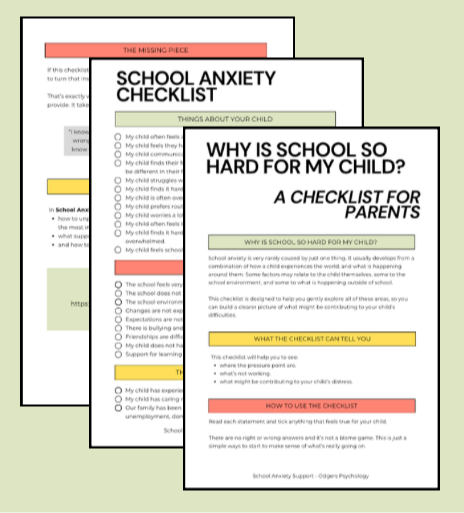
If you're trying to understand what might be driving your child's worries, you can download my free school anxiety checklist, which can help you identify some of the possible causes, and you can find a link in the captions below.
Want help making sense of your child’s school anxiety?
Download my free School Anxiety Checklist to quickly spot what might be driving your child’s school‑based worries, so you know where they most need support.
You’ll get a simple, parent‑friendly checklist you can use to:
- Get a clearer picture of why school feels so hard
- Spot where your child may need extra support at home and in school
- Feel more confident about what to raise with school staff and professionals

Nicky Odgers