MeLSA
Training & Supervision
Mediated Learning Support Approach
Schools work incredibly hard to support pupils, yet still see children who struggle to make progress despite thoughtful teaching and well-planned interventions. You may recognise:
-
Children who rely heavily on adult support and feel afraid to try things alone
-
Pupils who struggle to remember information, even after lots of practice
-
Children who feel they’ll never improve — so begin to stop trying
-
Learners whose progress is hindered by executive functioning difficulties such as in concentration, planning, or impulsivity
-
Staff who want to do more, but feel unsure what will make a real difference
-
Limited access to specialists when support or guidance is most needed
These challenges can feel disheartening — especially when everyone is doing their best to help children succeed.
MeLSA - A Different Way of Supporting Learners
The Mediated Learning Support Approach (MeLSA) was developed by educational psychologists to strengthen the support available within schools — not by adding more external services, but by building skill and understanding within the staff who work with children every day.
MeLSA offers a way to:
-
Understand the psychology behind how children learn.
-
Recognise what helps learning stick — and what gets in the way.
-
Build pupils’ independence, resilience, and willingness to take risks.
-
Support executive functioning skills such as planning, focus, and self-organisation.
-
Use strategies that develop confidence and long-term progress, not just short-term results.

At its heart, MeLSA is about empowering adults so children can become more confident learners. When staff have the tools to notice how thinking is happening — and what’s blocking it — they can offer support that leads to lasting change.
MeLSA doesn’t replace good teaching or specialist input. Instead, it strengthens what schools can do from within, helping learners move from relying on adults to develop their independence and academic learning skills.
How MeLSA Works
MeLSA provides schools with a structured, supportive way to develop staff skill, confidence and insight into how children learn best. The training is practical, reflective and rooted in psychological theory — but always grounded in the everyday reality of the classroom.
Here’s what the journey looks like:
-
Training
Staff take part in six days of interactive MeLSA training facilitated by educational psychologists.
They explore how learning happens, what gets in the way, and how to support children to think, reflect and solve problems independently. -
Practice
MeLSAs begin working directly with pupils, applying the strategies and principles in real learning situations.
This allows theory to become part of daily practice — not something left on a training slide. -
Ongoing supervision
Regular supervision and professional discussion deepen understanding over time.
MeLSAs continue to build skill, reflect on challenges, and share what’s working.
This simple but powerful model helps schools embed lasting change — not quick fixes, but a shift in how learning is supported across the system.
Feedback from MELSAs who trained with me in Autumn 25
Becca - Primary TA
"I have gained so much knowledge throughout this experience! This will now help me to develop an action plan to support in becoming more independent, confident, and resilient learners. It will also allow me to impart my knowledge to other TA's across the school to enable us to have a consistent approach focusing on scaffolding, guided questioning, task analysis, and language support.When teaching phonics/maths, I've really thought about the mediating puzzle and making things more 'concrete', by reducing the cognitive load and focusing more on the language I use. I'm looking forward to developing some interventions using the Precision Teaching method to focus on blending skills, as some of the children are still not able to do this consistently."
Danielle - Primary TA
"Having attended MeLSA training, I can confirm it has been one of the best courses I have been on.
After spending several years in education and seeing the needs of children change over years it's always great to find new ways to support them. This course gives you more than that, it gives you endless strategies and ideas to take away to your setting. It’s been a huge help already to a large group of children and I can’t wait to take it further throughout the school."
Catherine - Primary TA
"I work with a child with needs. He could not grasp how to do the work he was given. By going on a MELSA course, it has shown me ways to break down the work in a way he understands and at his pace."

The Finer Details
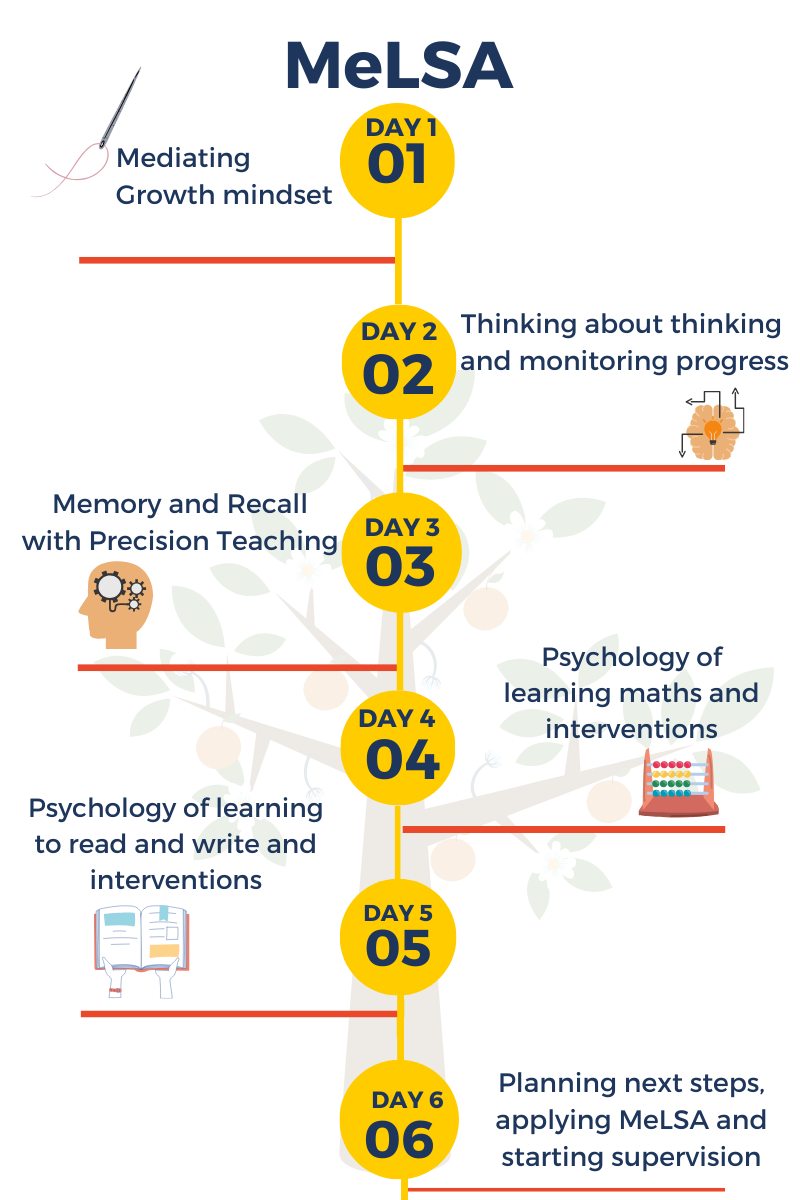
MeLSAs complete six 6 days of training.
- Day 1 - Mediating & Growth Mindset
- Day 2 - Thinking about Thinking.
- Day 3 - Memory & Recall
- Day 4 - Psychology of Learning Maths.
- Day 5 - Psychology of Learning to Read and Write
- Day 6 - Reviewing Learning / Making Action Plans / Starting Supervision
MeLSAs will be encouraged to complete tasks in between each session to consolidate their new knowledge and skills.
What Happens After Initial Training?
- Once MeLSAs have completed their initial training, they will be expected to attend group supervision with an educational psychologist for two hours every half term. Supervision provides continued learning and reflection.
- The title of MeLSA is only given to those who have completed the initial MeLSA training and are currently accessing regular supervision.
- All MeLSAs who train with me will automatically be offered a place in a supervision group.
Who can be a MeLSA?
MeLSA has already been delivered to a wide range of school staff — including learning support assistants, teachers, assistant SENDCos and SENDCos — across early years settings, mainstream schools, post-16, and alternative provisions.
MeLSA isn’t about a specific role or job title. It’s about adopting an approach and a shared way of thinking and working that helps children and young people grow into confident, independent learners.
What could a MeLSA do once trained?
- Work individually with struggling learners to investigate their skills and then foster independence.
- Work with small groups to develop targetted skills over a period of time.
- Used their knowledge during whole class work.
- Share MeLSA content with TAs they manage to support them when carrying out their work.
Frequently Asked Questions
How long does MeLSA training take?
How much does MeLSA training cost and what is included in the cost?
How much does supervision cost?
Can I get started before I've finished the training?
Register your interest in MeLSA training
This training will take place in or around Cambridge (venue to be confirmed).
Register your interest in MELSA by completing the form below
Once you've done that, I'll send you an email with further details.