
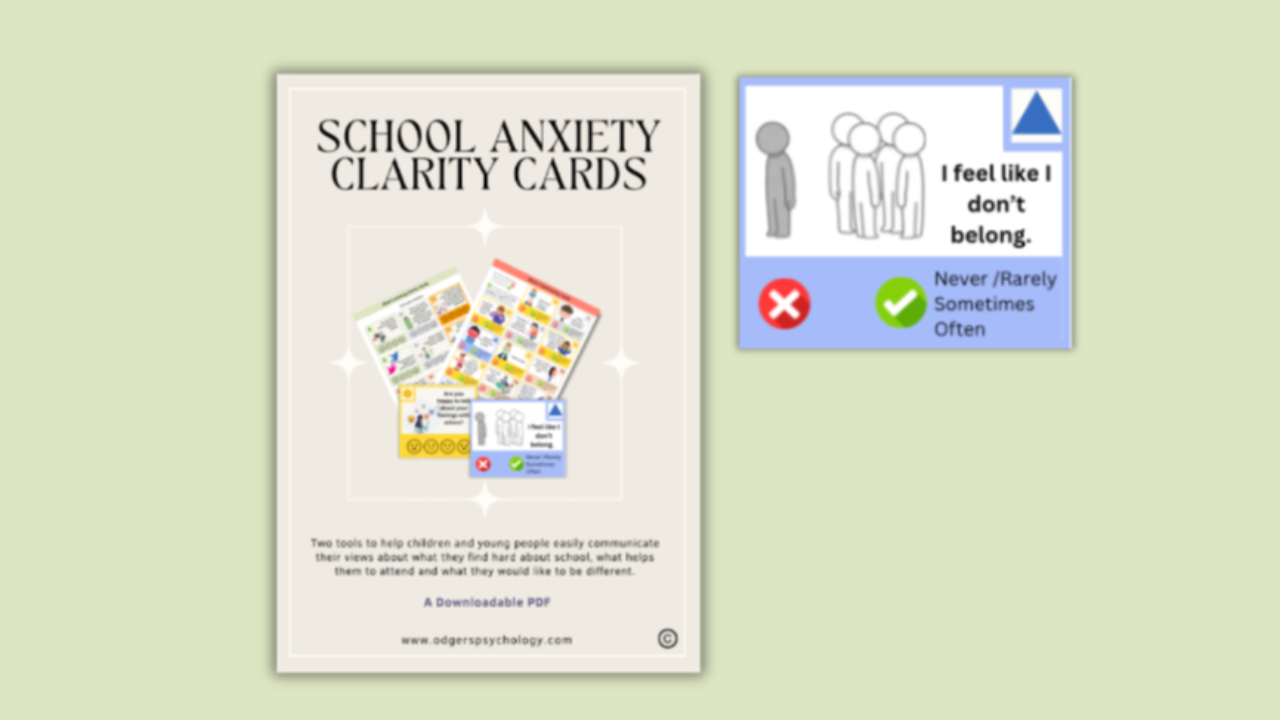
School Attendance Clarity Cards
A printable tool to help young people share what feels hard about school, what’s helping, and what to focus on first.
-
Instant digital download.
-
Print and reuse as often as you need in your family or educational setting.
What the cards help you do
When a child is anxious about school, it can be hard to know where to start. The School Anxiety Clarity Cards give you a simple, structured way to see what’s going on.
The cards help children show you:
- what they find difficult in school
- how important each issue is to them
- what support is already in place or missing
- what they would most like to change
You can then turn their responses into a clear summary and use it to build a support plan that:
- targets the issues they say matter most
- sets motivating, realistic goals
- plugs gaps in support at home or in school
- makes school feel easier and less stressful
What you get for £14
- Downloadable PDF you can print as many times as you need
- 42 “What’s hard?” cards for specific school‑based difficulties
- 24 “What’s working?” cards to show what is going well and what support is in place
- Flexible format: questionnaire or card‑sorting activity
- Colour‑coded cards so you can spot themes and priorities at a glance
Useful for children and young people aged roughly 7–16, and can be used by parents, teachers, SENCOs, ELSAs, pastoral staff, attendance leads and educational psychologists.
Why these cards are different
Unlike most questionnaires or card sets, the Clarity Cards show you how important each issue is to the young person.
The colour‑coding makes it easy to spot themes and priorities at a glance, so you don’t just get a long list of worries – you get a clear picture of what to focus on first.
The cards are a core tool in my School Anxiety Support (SAS) online course (£127); here, you’re getting that framework on its own for £14.
[ Terms of use- The cards are for personal use and are not to be sold or changed in any way. If they are distributed, attribution must be given to Odgers Psychology.]